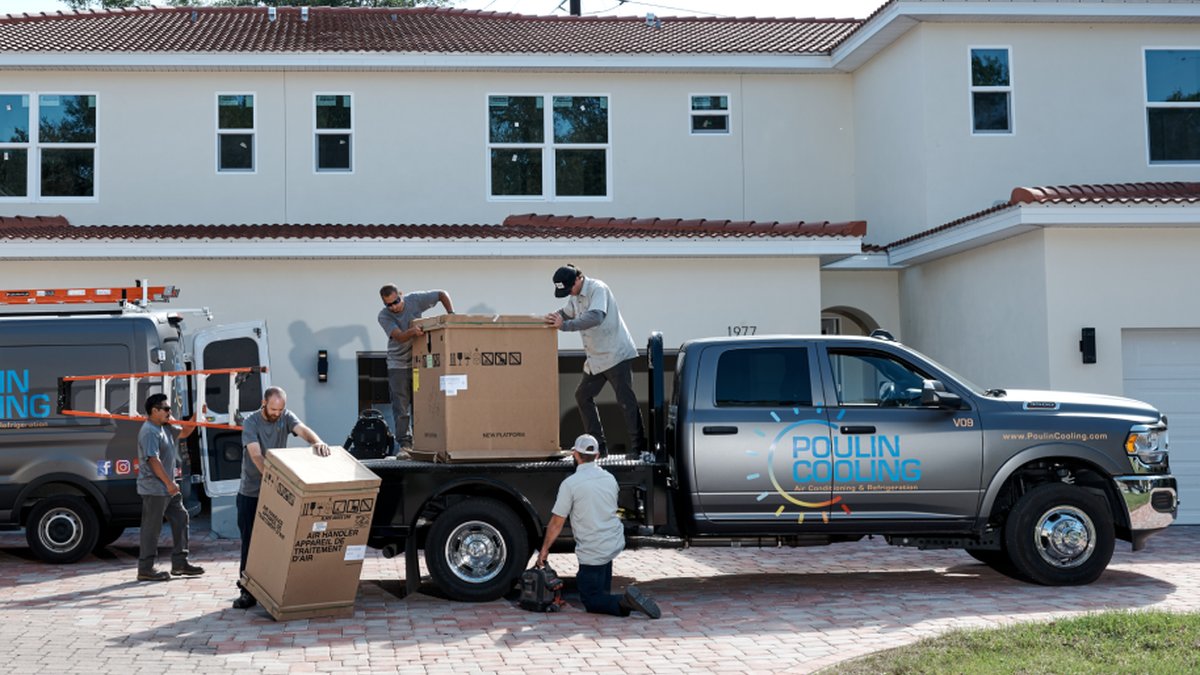
Poulin Cooling
AC Repair
2930 Ulmerton Rd, Clearwater, FL 33762, Clearwater, FL
(727) 353-9828
Family-owned, fast same-day response
View profile
Local Trade List connects residents in Clearwater, Orlando, Houston, and Chattanooga with licensed AC repair contractors whose credentials hold up to scrutiny.

| Type | Description |
|---|---|
| Central AC Repair | Central AC repair is the diagnosis and restoration of split-system and packaged cooling units. Technicians test compressors, capacitors, contactors, and refrigerant circuits to pinpoint the failure. |
| Refrigerant Leak Detection and Recharge | Refrigerant leak detection is a required step before any recharge. Technicians use electronic leak detectors or UV dye to find the breach, repair it, then restore the charge to manufacturer specification. |
| Compressor Replacement | Compressor replacement is the most labor-intensive single repair in residential AC service. Compressor failure shuts down cooling completely because refrigerant stops circulating, and Houston and Florida summers put compressors under heavy sustained load. |
| Evaporator and Condenser Coil Service | Evaporator and condenser coils are heat-exchange surfaces that accumulate dirt, scale, and biological growth. Technicians clean and inspect coil fins to restore heat transfer and prevent compressor damage from restricted airflow. |
| Thermostat and Controls Repair | Thermostat and controls repair is the diagnosis and correction of faults in the system's wiring, sensors, and control board. Short-cycling, failure to reach setpoint, and unresponsive controls often trace to wiring errors rather than the compressor or air handler. |
| Air Handler Repair | Air handler repair is the service of the indoor fan cabinet, blower motor, drain pan, and condensate line. Failed blower motors, clogged condensate lines, and cracked drain pans are common failures in humid climates like Clearwater. |
| Emergency AC Service | Emergency AC service is same-day or after-hours response to a complete system failure. Florida and Texas summer heat makes a failed AC a serious health risk, so Clearwater, Orlando, and Houston contractors frequently offer priority dispatch. |
State licensing requirements differ between Florida, Texas, and Tennessee, so verifying a contractor's current license matters before any job. Florida requires HVAC contractors to hold a state license from the Department of Business and Professional Regulation. Texas issues HVAC technician licenses through the Department of Licensing and Regulation. Tennessee contractors answer to the state Contractor Licensing Board. A license lookup on each state's public database takes minutes and confirms whether the contractor and qualifying agent are current.
Beyond the license, check that any technician handling refrigerant carries EPA Section 608 certification, a federal requirement. NATE certification from North American Technician Excellence is an additional credential that signals tested field competency rather than on-the-job experience alone. Poulin Cooling, ACS Home Services in Clearwater, and Cox Heating & Air Conditioning each serve specific metro areas. Matching the contractor to your city focuses the search on providers who know local code and climate conditions.
Manifold gauge sets read system pressures on both the high and low refrigerant sides. Digital clamp meters and capacitor testers diagnose electrical faults. Refrigerant recovery machines capture refrigerant before any repair, since EPA regulations prohibit venting it to atmosphere. Nitrogen tanks let technicians pressure-test a repaired circuit before recharging. Thermal imaging cameras locate hot spots in electrical panels without disassembly.
EPA Section 608 certification is a federal requirement for any technician who purchases or handles refrigerants, covering four categories based on equipment type. Florida's HVAC contractor license comes from the Department of Business and Professional Regulation and covers both contractor and journeyman tiers. Texas issues HVAC technician licenses through the Department of Licensing and Regulation. Tennessee requires an HVAC contractor license from the state Contractor Licensing Board. NATE certification, from North American Technician Excellence, tests technicians on specific equipment types including air conditioners, heat pumps, and air distribution systems.
HVAC programs run at community colleges, trade schools, and technical institutes across Florida, Texas, and Tennessee. Lincoln Tech, Universal Technical Institute, and Fortis College offer focused HVAC programs ranging from several months to two years. Apprenticeships through Sheet Metal Workers locals pair classroom instruction with supervised field hours. Manufacturer training from brands like Carrier, Lennox, and Trane certifies technicians on specific product lines and diagnostic software.
A standard AC call starts with a visual inspection of the outdoor condenser, indoor air handler, and accessible ductwork. Technicians measure supply and return air temperatures to confirm the expected temperature split across the evaporator coil. Refrigerant pressure readings on both sides of the circuit reveal whether the charge is correct or a leak is present. Capacitor and contactor testing under electrical load flags failing components before a full breakdown occurs. Clearing the drain pan and condensate line prevents water backup, a common problem in humid markets like Clearwater and Houston.
AC Repair
2930 Ulmerton Rd, Clearwater, FL 33762, Clearwater, FL
(727) 353-9828
Family-owned, fast same-day response
View profileAC Repair
13831 US Hwy 19 N, Clearwater, FL 33764, Clearwater, FL
+1727-510-2032
View profileAC Repair
515 N Myrtle Ave, Clearwater, FL 33755, Clearwater, FL
+1727-201-0914
View profile
AC Repair
2930 Ulmerton Rd, Clearwater, FL 33762, Clearwater, FL
(727) 353-9828
Family-owned, fast same-day response
View profileAC Repair
515 N Myrtle Ave, Clearwater, FL 33755, Clearwater, FL
+1727-201-0914
View profileAC Repair
2198 Calumet St, Clearwater, FL 33765, Clearwater, FL
+1727-442-6158
View profileAC Repair
13831 US Hwy 19 N, Clearwater, FL 33764, Clearwater, FL
+1727-510-2032
View profileAC Repair
2071 Range Rd, Clearwater, FL 33765, Clearwater, FL
+1813-607-5117
View profileAC Repair
22085 US Hwy 19 N, Clearwater, FL 33765, Clearwater, FL
+1727-669-4300
View profileYes. Florida, Texas, and Tennessee each require HVAC technicians or contractors to hold a current state-issued license. Florida licenses through the Department of Business and Professional Regulation, Texas through the Department of Licensing and Regulation, and Tennessee through the Contractor Licensing Board. Hiring an unlicensed contractor puts homeowners at risk for unpermitted work and no recourse on failed repairs.
Yes. Most AC repairs involve checking or restoring the refrigerant circuit, and federal law under EPA Section 608 prohibits venting refrigerants to atmosphere. Any technician who purchases or handles refrigerants must carry EPA 608 certification. Recharging a system without fixing an existing leak means the refrigerant loss repeats within one to two seasons.
Repair targets a specific failed component, such as a capacitor, compressor, or refrigerant leak, while replacement swaps the entire condenser unit, air handler, or both. Technicians typically recommend repair for systems within their service life and replacement for units older than 12 to 15 years or those with compressor failure. Repair cost versus equipment age drives that decision, and a licensed contractor frames the options clearly.
Most residential AC repairs take one to three hours. Straightforward fixes, such as a failed capacitor or a dirty condenser coil, finish in under an hour. Compressor replacement runs four to six hours or longer depending on refrigerant type and system size. Emergency calls in Houston and Orlando, where summer heat puts AC systems under constant strain, sometimes run longer if parts need ordering.
No, routine maintenance and minor repairs do not require a permit in most jurisdictions, but equipment replacements and system installations typically do. Florida and Texas both require permits for significant HVAC work, and the licensed contractor pulls the permit on the homeowner's behalf. Skipping a required permit leaves the work uninspected and creates liability during a home sale.
Loss of cooling on a hot day most often traces to a failed capacitor, a tripped breaker, a refrigerant leak, or a frozen evaporator coil. Capacitor failure is the most common summer breakdown because capacitors degrade faster under sustained electrical load. A frozen coil stems from low refrigerant, a blocked filter, or restricted airflow. Technicians in Houston and Clearwater see these patterns every summer.